

[ad_1]
A Texas boot model planting roots within the coronary heart of SoHo is curious sufficient.
However the actual shock inside Tecovas’ first New York retailer might be discovered in direction of the again: a full bar serving beers, bourbons and previous fashioneds — all on the home, no buy obligatory. In reality, drinks are free in any respect however one in all Tecovas’ 50 shops nationwide.
Tecovas’ generosity of spirits — what it calls “radical hospitality” — is among the many bolder makes an attempt to unravel a perennial query in retail: learn how to persuade prospects to linger in shops. For a rising variety of retailers, the time a client spends of their area is the purpose — even when they go away with out making a purchase order. The considering goes that, if prospects wish to move the time inside a model’s world, and invite their pals alongside to hang around there too, the gross sales will ultimately comply with.
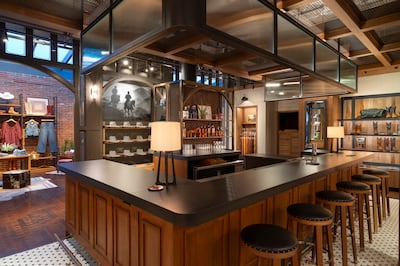
“If somebody’s coming in to say, ‘I’m going to fulfill somebody right here,’ then which means we’ve cracked the code,” stated Kim Heidt, chief retail officer at Tecovas. “It’s all about making the purchasers really feel snug, and simply being part of their neighborhood.”
Combining consuming, ingesting and purchasing isn’t a brand new thought. Department shops and malls have at all times included eating choices. Armani and Ralph Lauren opened eating places within the Nineties and now function world hospitality empires; Dior, Gucci and Louis Vuitton have gone down an analogous path within the final decade. Aimé Leon Dore and Maison Kitsuné reside proof that good espresso can deliver foot visitors to a retailer.
Tecovas and different manufacturers aren’t aiming for a Michelin star. However they’re following a extra intentional philosophy to designing their shops, one impressed by what’s popularly known as a “third place.” The time period, coined by sociologist Ray Oldenburg in 1989, describes the sorts of areas — public parks, neighborhood centres, even barbershops — that function a house away from house, the place pals and neighbours can run into each other and easily move the time.
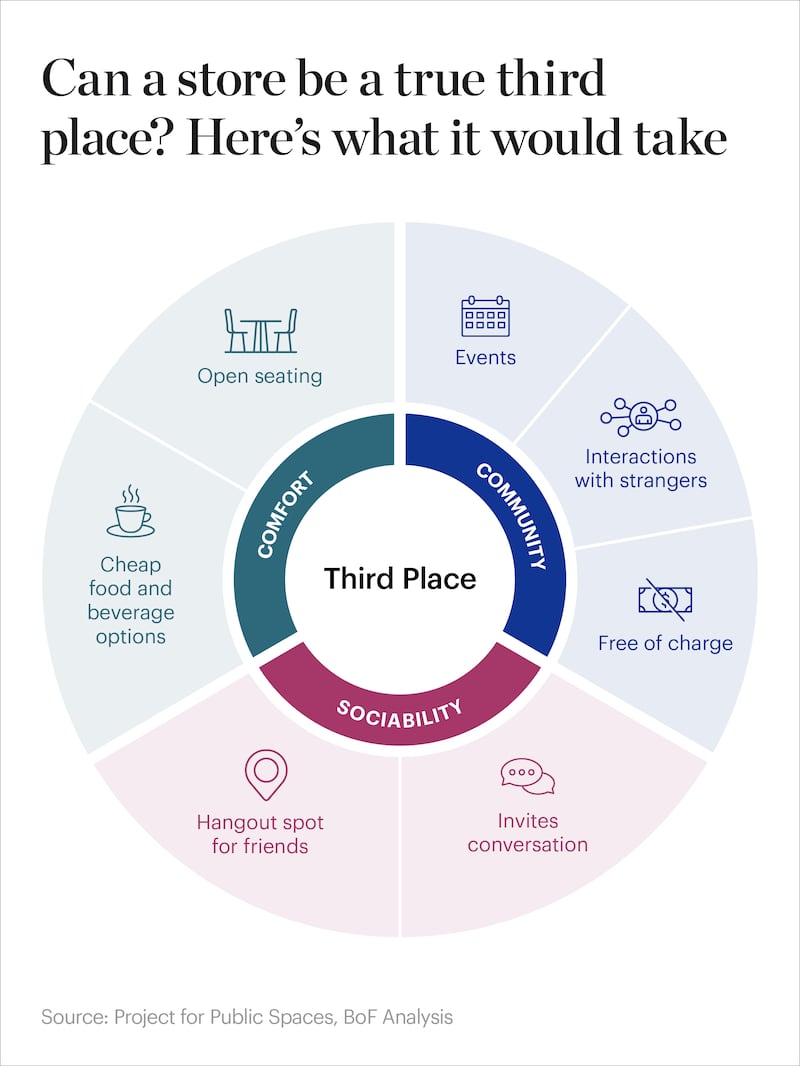
As of late, third locations are sometimes seen as a vanishing breed, with individuals too glued to their smartphones even once they go away their properties to socialize in the actual world. When the pandemic struck, pushing the whole lot on-line and relegating bodily life to the background, the issue acquired worse. Impulsively, individuals had nowhere to hang around in particular person, even once they needed to. Google searches for the “third place” started climbing steadily in late 2021, quickly after a majority of People had acquired the Covid vaccine.
Shops — and eating places and low chains and luxurious gyms and non-alcoholic bars and Casa Cipriani and working golf equipment — have all made a play to fill that want.
In an earnings name earlier this 12 months, Starbucks executives used the phrase “third place” seven instances whereas touting new, community-minded attracts reminiscent of free refills and restrooms open to everybody. Final month, baggage maker Monos opened Postcard, a “listening bar” subsequent to its Chicago outpost, serving each espresso and cocktails, with plans for extra places. In July, Coach introduced it should open dozens of espresso outlets inside its shops.
Oldenburg, who died in 2022, in all probability wouldn’t have permitted of most of those efforts. He noticed true third locations as, if not fully commerce-free, constructed for the aim of human interplay, together with between strangers. Even malls, initially conceived as a solution to the isolation of the suburbs, fell effectively wanting fulfilling that operate within the tutorial’s eyes.
Do branded espresso muffins, cozy couches and dependable Wi-Fi — and even limitless free cocktails — make a retailer a real third place? Is the target to actually create neighborhood, or is that this merely the subsequent iteration of “experiential retail,” one other faddish means of dressing up the pursuit of income?
Kelly Verel, co-executive director of the Mission for Public Areas, a nonprofit organisation devoted to bettering public areas, has her doubts about retail’s capability to behave as a 3rd place.
“I’ve by no means heard of a magnificence or trend retail location categorised in that means and I battle with it — I’m undecided why,” she stated.
The Subsequent Finest Factor
After reflecting for a second, Verel did establish one retailer that comes near fulfilling the mission of a 3rd place: Sephora, with its testing stations and tolerance for patrons who are available in simply to browse and even contact up their make-up.
Many new shops aspire to fall someplace in the midst of the spectrum between being purely pushed by commerce and offering a public commons. They hope to be a part of prospects’ on a regular basis lives, past purchasing.
“The target is that they arrive again and so they inform their pals about it,” stated Victor Tam, co-founder and chief government of Monos.
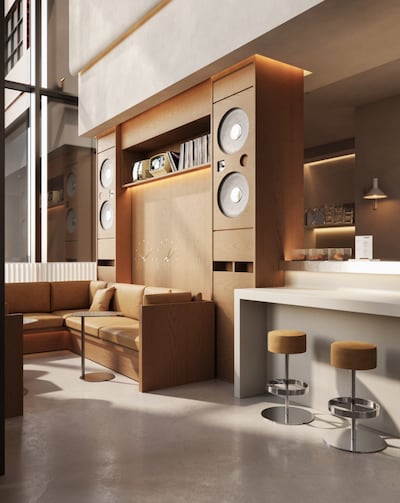
Style retailers, with their inherent emotional enchantment and knack for niche-making, have a greater shot than most retailers at creating a real communal area, stated James Gilchrist, vp of the Americas division of Comme des Garçons and Dover Road Market, which is among the many first specialty retailers to open cafés inside its retailer, again when the concept was nonetheless novel within the early 2000s. Dover Road’s Paris location homes its personal nonprofit organisation that hosts free exhibitions, artwork exhibits and performances.
“Style was at all times type of a 3rd place,” he stated. “At impartial shops, you’d meet the house owners. … It was a spot for patrons to find and to perhaps escape a bit bit and meet likeminded individuals.”

And regardless of the limitless rumination over what a 3rd place is and isn’t, the concept of neighborhood itself nonetheless rings true to many within the business.
Designer Thebe Magugu hadn’t heard of third locations earlier than opening his retailer and gallery area, Magugu Home, in his native Johannesburg final 12 months. However he stated it’s an idea that’s paying homage to ubuntu, a Zulu phrase which means interconnectedness.
At Magugu Home, the designer hosts Sunday evening events, movie screenings, salon-style occasions and a rotating exhibit of native artists.
“It’s an thought of an area the place there are such a lot of intersections,” he stated. A second location will open later this 12 months in Cape City as a part of Mount Nelson, a Belmond Lodge.
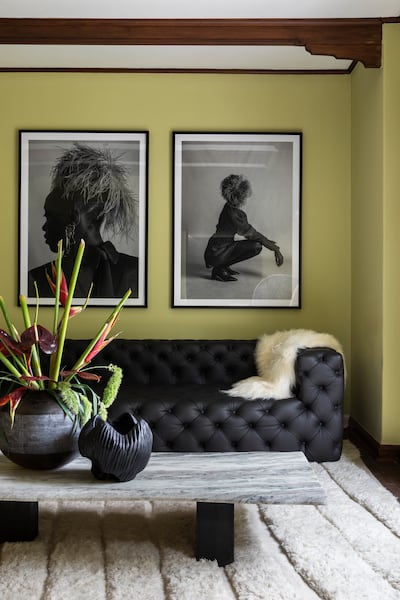
“The thought of a 3rd place I really feel is so African,” stated Magugu. “I grew up in a small city, the place there weren’t plenty of areas for expression. One area has to serve numerous individuals, and we had a storage that cleared out in the course of the day so I may do my tasks and at evening it changed into a tavern which introduced individuals collectively within the night.”
Loitering Inspired
To make certain, on some degree commerce is at all times nonetheless the purpose. One other title for what these manufacturers are doing is “soft-selling,” in response to WGSN retail strategist Candice Medeiros. Retailers use open areas, free providers and numerous facilities to create long-term relationships with prospects. Along with rising time spent in retailer, these techniques, when finished effectively, make consumers extra prone to return, full a purchase order on-line or unfold constructive phrase of mouth.
“Dwell time is the brand new ROI for retailers,” stated Medeiros. “This has so much to do with social isolation. Customers are in search of offline areas and wanting to collect in these areas, and it’s a chance for retailers.”
This may be achieved with surprisingly small touches.
Apple was an early adopter of the “loiter” method, stated Chris DeCrosta, co-founder of actual property agency Goodspace. The tech big welcomed everybody into their shops, he stated, together with individuals who simply needed to cost their telephones, examine their emails and use the services.
“Apple realised that having individuals of their ecosystem meant they have been intertwined with the model,” he stated. “It’s about making individuals snug together with your model.”
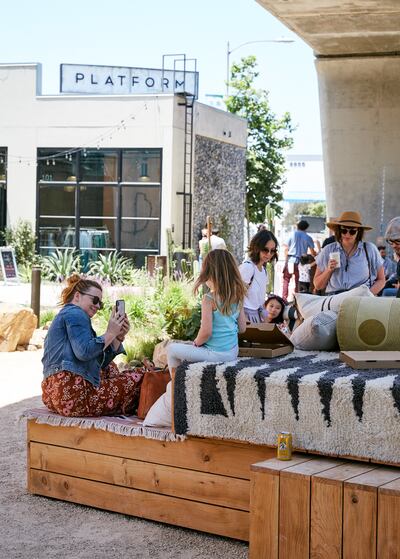
Others are adapting the previous mall idea for smaller areas. Platform, for example, is a 75,000-square-foot purchasing centre in Culver Metropolis that homes a potpourri of trend, meals and residential items choices in a walkable promenade hidden from road view. The thought is for somebody to have the ability to spend a whole day primarily loitering at Platform, from breakfast to dinner, and never get bored, stated Joseph Miller, the Los Angeles-based developer behind the venture.
“I’m undecided if anybody wakes up within the morning and says, ‘I wish to go purchase one thing in the present day,’ however there’s a big share that get up and say, ‘I wish to hang around someplace in the present day,’ and that’s what we’ve constructed our firm to do,” he stated.
Bottoms Up
Tecovas, Coach and Ralph Lauren are doing one factor Oldenburg would undoubtedly approve of: providing their prospects drinks.
In one in all his final items earlier than his dying, he referred to as drinks — alcoholic, caffeinated or just moist — a key criterion for creating a 3rd place.
“The third place, usually, is a watering gap of 1 type or one other, and dialog is the primary exercise,” Oldenburg wrote in a UNESCO Courier piece, co-authored by Karen Christensen. “The final rule is that drinks are of such significance as to turn into veritable social sacraments.”
For Miller and his enterprise associate, David Fishbein, the final rule of thumb of getting individuals to hang around of their retail centres is to have what they name “low-commitment F&B” — espresso or low cost snacks — and a few outside seating to benefit from the temperate LA climate. Coach will roll out its espresso home idea primarily in outlet malls at first as a result of they usually lack many different choices for refreshments.
Nonetheless, there’ll at all times be doubters that any retailer can create a totally realised third place.
“A few of these café ideas constructed round high-end manufacturers — in some way they appear a bit compelled,” stated Glenn Pushelberg, one half of the inside design agency Yabu Pushelberg. “Am I being branded to dying?”
[ad_2]
Source link


