

[ad_1]
A brand new Transport for London promoting marketing campaign doesn’t replicate the gloomy actuality of its personal efficiency figures
When bus passengers are requested about their priorities, reliability at all times comes high. The explanations are apparent: commuting time to work, parenting commitments, assembly mates, hospital appointments or getting to highschool. Figuring out a bus will arrive frequently and that you’ll attain your vacation spot in an affordable time is prime to journey alternative, in case you have one.
So once I learn a Transport for London poster at Dalston Kingsland station not too long ago, with its message about bus journeys “getting brighter”, it angered me sufficient to refer it to the Promoting Requirements Authority. The poster could also be cleverly worded, but it surely isn’t truthful. You must return to the early years of this century to search out bus reliability figures as dangerous as they’re now.
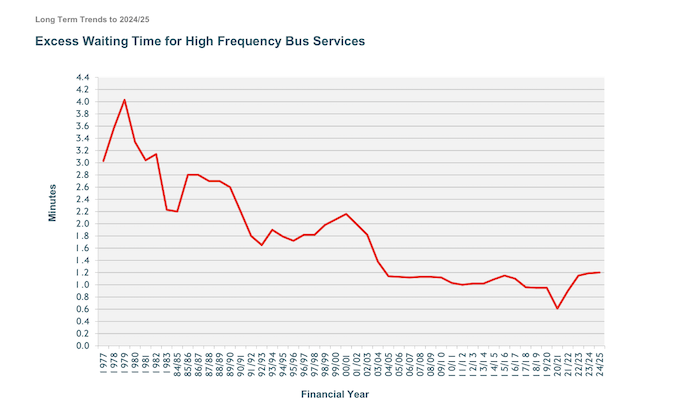
Transport for London was established in 2000 and really quickly was extremely happy with what it achieved for bus passengers in a remarkably quick area of time. The chart beneath of “extra ready time” dramatically demonstrates the enhancements in reliability between the late Nineties and early 2000s. This was delivered initially by an energetic Authorities Workplace for London after which by TfL itself. The typical period of time London bus passengers needed to wait past the scheduled interval was halved.
The primary Mayor of London, Ken Livingstone, understood what mattered to bus passengers and focussed TfL’s consideration accordingly. He used a mixture of measures to attain this intention, each bodily and monetary. On the coronary heart of his insurance policies was the so known as “high quality incentive contract”, a mixture of bonuses and penalties for bus operators to run their contracted bus mileage, and to take action reliably.
Major amongst the opposite measures was the London bus initiative, which launched over 200 bus precedence lanes throughout town and, crucially, enforced them with cameras. Oyster ticketing diminished boarding occasions. And, after all, congestion charging was the simplest area-wide technique for growing bus precedence. The funding from scheme was directed in direction of new and higher providers.
The development continued within the early years of Boris Johnson’s time as Mayor, sustaining a golden period for bus passengers, with extra frequent providers, extra routes and route extensions. Passenger ranges rose quickly to six.5 million journeys a day.
However his good work didn’t final. A second spherical of bus precedence and a second new contract regime to incentivise high quality of service had been deserted and the western extension of the congestion cost zone was eliminated. And in his second time period, from 2012, Johnson appointed Andrew Gilligan, a journalist buddy and fanatical bike owner, as his “biking czar”.
The main target of London streets coverage turned dramatically from tackling congestion and additional enhancing London’s most necessary passenger service, the bus, to London’s smallest personal transport mode, the bicycle. Cycle Superhighways and mini-Hollands consumed a lot of TfL’s power and eye-watering sums of cash for the subsequent 4 years. Bus lanes had been transformed to cycle tracks and motorcar capability was diminished in favour of cycle precedence.
With large quantities of disruption resulting from highway works, the lack of bus lanes and general motorcar capability at key junctions throughout inside London, the inevitable occurred – bus journey occasions declined. TfL and the bus operators did their bit to take care of efficiency by adjusting site visitors lights to favour buses, shortening bus routes and bettering their management of providers. TfL officers undertook plenty of work to ascertain {that a} decline in passenger numbers was linked to slower bus speeds.
Sir Sadiq Khan’s mayoralty carried on the place Johnson’s left off. A brand new biking and strolling commissioner, Will Norman, continued Gilligan’s deal with bicycles, this time below the duvet of a “wholesome streets” agenda. There has these days been some recognition of the injury being finished to the bus service – therefore the poster. However there are inherent contradictions: a part of TfL is placing in bus lanes and different bus precedence measures, whereas one other half is taking out bus precedence and eradicating motor capability from bus routes in favour of cyclists.
Because of this, bus service efficiency is the worst it has been since Livingstone’s first time period. Reliability is worsening, as proven within the chart. Bus speeds are the slowest they’ve for the reason that reporting mechanisms of TfL’s I bus system had been launched in 2013. TfL have missed their bus journey time goal for the final three years, regardless of that focus on being slackened. And what of the actions the poster describes for making bus journeys “brighter”?
A plan revealed in 2022 promised to regulate site visitors sign timings, add bus lanes and enhance the hours of operation. These are good issues to be doing. Nonetheless, the foundation of the issue is that while there could also be insurance policies supporting buses, London authorities has been, and continues to, be far too informal about bus efficiency. The dimensions of the trouble to show across the decline is woefully insufficient. There are neither the insurance policies nor the dedication to do extra. Bus journeys aren’t about to get brighter anytime quickly.
Vincent Stops is a former Hackney councillor and lead member for transport who labored on streets coverage for London Travelwatch, the capital’s official transport customers’ watchdog, for over 20 years. Observe him on X/Twitter.
Associated
[ad_2]
Source link


